Music


Fresh List
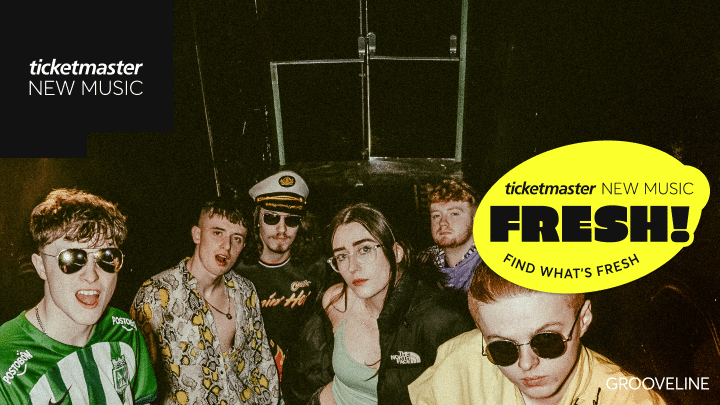
Ticketmaster Fresh List 2026: Grooveline
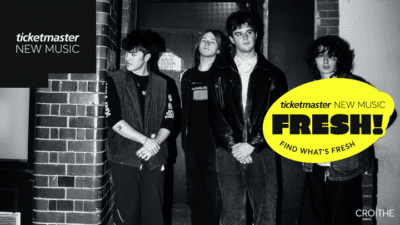
Grooveline are our Ticketmaster Fresh List artist this month! We caught up with the band to chat about musical roots, touring, the Irish language and more.
Can you introduce yourself?
Tarach: What’s the craic? We are Grooveline, my name is Tarach.
Bainsy: And my name is Bainsy, and we are your Ticketmaster Fresh artist for March 2026.
How did the band start?
Bainsy: The band started because we were all in school together. Basically, I’d been playing with this guy (points to Tarach), since we were about five, six years old. And our drummer, Bronwyn and our guitarist Matthew, were all in the Gaelscoil in Manor, and we all were basically just playing along together. We cycled through so many band names we had, like The Jokers, Zero Gravity…
Tarach: Real cringe.
Bainsy: Real cringe ones. And there was a little music thing which happened every summer called The Rock School. And basically we all would form bands there, and then over the week, you’d kind of learn original songs, some covers, and then play a show at the end. And that’s kind of where we met Cian, who plays keyboard and fiddle. And then we met Glen in secondary school. So it all kind of came along when we were very young.
Tarach: Like the whole gist is that we grew up together. We, most of us, went to creche together. We formed in primary school, and then kind of throughout teenage years, got Cian involved, but we all grew up together in the same tiny, tiny middle of nowhere village. We’re from Cluainín Uí Ruairc, it’s Anglicised name is Manorhamilton, cool enough town, pretty small.
Bainsy: I like saying it’s the epicentre of North Leitrim, which isn’t saying much, but we will take it. We played a lot of gigs in Sligo when we were young, as well as. South Donegal, Bundoran, Ballyshannon, that’s kind of where it all began. And then we all went to college in Dublin and Maynooth.
Tarach: And then three of us dropped out. That’s a sign that we’re doing well.
How would you describe your music?
Tarach: Six piece, high energy, bilingual, Fenian funk, that’s how I describe it. Imagine like Nile Rodgers and Chic, but with the energy of a punk band, but it’s definitely not punk. It’s very in your face, dance music. I feel like in Ireland at the moment, I don’t know, maybe we’re trying to understand our identity better, but there’s a lot of heavy stuff going on at the moment in Ireland, and a lot of that’s coming through, like heavy rock, indie music. And not that we have a problem with that, but there is a space for buzz in this place and I think Ireland needs a bit of buzz. We have Kneecap who are savage, but I feel like we’re this six piece, funk, lighter version of Kneecap.
Bainsy: I think our sound has really changed a lot from where we started. When we were kids, the kind of music scene around Leitrim at the time was the Rock School, Bundoran, Ballyshannon, which, of course, had the Rory G (Gallagher) festival and everything. So the kind of main influences for music, especially around us, were kind of rock and blues, in a way. So that’s kind of where it started from. And of course, we also had the Irish language element in there, because we went to the Gaelscoil and we won a competition called Comhaltas Beo, which is an Irish songwriting competition. So we had that blues and Irish language kind of fusion going on. And then I learned saxophone, and Cian joined with keys and fiddle. So then we were like, geez, we can’t be rock and blues.
Tarach: And then we were very confused.
Bainsy: So then, like all bands, our influences changed. We went from kind of (Red Hot) Chili Peppers, Arctic Monkeys, towards more Chic, Nile Rodgers, that sort of area, Vulfpeck as well. So we started bringing in that side of it, and started bringing in more rapping, and it just turned into this kind of genreless mess of music which we create.
Tarach: Yeah, it’s totally our own, but it’s open to everybody who considers themselves an absolute buzz junkie.

In your songs, you sing in both Irish and English. Is using the Irish language something that’s important to you?
Bainsy: 100%
Tarach: Absolutely.
Bainsy: I mean, like. I won’t lie, some of our biggest opportunities came from us singing in Irish as well. And I think in a weird way, in the early days, it almost felt a bit like a chore, because we were still out of that, like school environment where I was like, Oh yeah, we’re doing Irish there. And then as we got older we started actually writing in Irish. Instead of just merely translating our songs into Irish, we start to really feel like, Oh, this is a whole avenue of music making which we could actually go into and make our own with our kind of style. So we love it.
Tarach: It’s something that comes natural to us anyway, because we grew up in, not in a Gaeltacht area, but there was a strong Irish language community there. So like, if we’re on a night out, we’d be speaking half as Gaeilge, half as Bearla the whole night anyway, which is just something that comes natural to us. When we’re out partying or we’re out socializing, we’re speaking in Irish and in English. Our music and our lyrics are just more of a reflection of what we get up to really.
Who are your influences?
Tarach: Well, I think what Grooveline is, is there’s such a vast amount of musicians, six musicians in the band, all with totally, totally different influences. And it kind of comes together, and we all find the common ground with our own influences. So for me, personally, like since I was a kid, Kneecap have been one of the biggest things for me growing up, because it gave a voice to Irish language communities in Ireland that never would have had a voice, especially in youth. And then also Trad groups like Kíla, and then also Nile Rodgers and Chic for me, was a huge one.
Bainsy: I think, an important influence which we had early on, which kind of set a good groundwork for what Grooveline was, was our initial love for Kíla, which we were listening to as a band when we were very, very young, and we loved their music. It was the first concert I’d personally ever been to. They’re this Trad, really high energy band. And also then when we went into secondary school and we met Glen, Glen introduced us to Red Hot Chili Peppers which brought the kind of rock funk element. So we were like, if we can make music which gives that rock funk kind of style of the Chili Peppers, and then mix it with that super high energy in your face, Kíla kind of sound, and somehow try and bring them together. That would be really cool.
Tarach: And I think we’re getting there. *Laughs*
Bainsy: We’re getting there. But even today, like you said, with how we’ve kind of gone towards Nile Rodgers, more hip-hop, even, like, drum and bass in some aspects, that initial kind of thing is still there from that kind of funk Chili Peppers thing.
You’re just back from a UK Tour, how was it?
Tarach: Unreal, absolutely wicked. We played Glasgow, Edinburgh, Bristol, London and Brighton and loads, like hundreds of tickets sold. It was absolutely class craic.
Bainsy: It completely wasn’t what we were expecting in every way, in terms of the tickets which we sold, the amount of people, which turned up, especially for our London show, yeah, and Bristol as well, cities which we didn’t think we had any reach. And then you have 70, 80, people turn up and then 300 for London, which was amazing. And also, it just went so smoothly, which, as an independent band, you know, when we’re booking [can be challenging] and shout out Matthew for booking it, because he did an unbelievable job. But things went so smoothly, and it just felt like a big holiday, to be honest.
Tarach: Yeah, we were just sessioning every evening. We were just going on the pints every evening.
Bainsy: But it was still tough, still tough.
Tarach: Oh yeah, it was tough. But like it was… we had our fun.
Bainsy: We had our fun. And also big ups to my father, Malcolm, who drove us the entire way around in the van. So big ups to him.
Tarach: Edinburgh to Bristol, took us 12 hours.
Bainsy: He drove, we fell asleep, at I want to say 3am or 4am, literally in a side street in Edinburgh, and we all woke up at 10am in a different country. He had driven from six am onwards. He was showing me from while we were all still completely asleep. And he was just on a mountain with snow everywhere. And we had no idea. He put an absolute graft in.
What would be your dream venue to play?
Tarach: Dream venue? The Button Factory on 24 April!
Bainsy: That’s my dream venue.
Tarach: I know, to be honest, when we moved to college here four years ago, which has, for me, ceased, 24 April at the Button Factory was always in my mind.
*laughter*
Bainsy: But no to be fair, I have a vivid memory of going to see Kíla, when we were like ten years old, and we were obviously too young to get in.
Tarach: So they snuck us round the back.
Bainsy: Rossa, his (Tarach’s) dad, brought us through the side entrance, and we went up all these windy stairs and ended up at the gantry bit at the top. And it was so much fun.
Tarach: It’s a great word. Gantry.
Bainsy: Got that from-
Tarach: Mr. Blindboy was it?
Bainsy: No, no, no. Got that from the Premier League.
Tarach: You got from the Premier League? Gantry?
Bainsy: The commentary gantry! Come on like!. Anyways, so that was a dream venue for us. But in terms of like proper dream venues, we’ve always said 3Arena or something.
Tarach: 100% 3Arena.
Bainsy: Vicar Street, is another. We played Vicar Street about, was it what, two years ago now?
Tarach: Yeah, a year and a half, we supported Kneecap at Vicar Street, good craic.
Bainsy: It was an amazing experience. And I think from that show and seeing how much people loved us, especially in like, supporting Kneecap, we were like, we should absolutely do our own show here. But then in terms of crazy dream venues, I think The Sphere would be pretty savage. Bono if you’re listening, get Grooveline in The Sphere. Now that would, yeah, that would create a whole new thing.

Do you have any backstage rituals?
Tarach: Actually, just keeling hard. Everyone asks us this, and they’re like, what’s your pre stage ritual? And we’re like, genuinely just this: *sinks into chair* And then scrolling on a bit of Reels, like.
Bainsy: Absolutely, yeah, we don’t have any rituals, no, just try and get as much sleep and rest in as possible.
Tarach: And then just save the energy to go hectic on stage, I suppose.
What is your most memorable live experience?
Tarach: There are so many! We’ve played so many shows!
Bainsy: First thing that comes to mind is probably Vicar Street, just because of the feeling. It felt like going on stage, supporting Kneecap, and seeing that, and just being on that stage was mind blowing. But then in more recent memory…
Tarach: I’d say, when we finished off EP (Electric Picnic) at The Salty Dog in 2025. We were the last band to play EP on Sunday night. Finished the whole thing off, and it was wired to the brim like there were so many people there. Everyone from the very start were moshing and crowd surfing. It was unreal. And that had been a dream stage for us to play on for absolute years.
Bainsy: And when I look back at it was a mad experience, because it felt so surreal, and we were so happy to play it. And we got up on stage, and we were all kind of thinking like, oh, please just nothing go wrong. And then, bless, Glen, our bassist, there were problems with his bass, like in the first few songs, so it was like, stress, stress, stress, stress. We got it sorted out, and we played the second half, and I remember coming off that stage being like, yeah, that was something. That was really, really something.
Tarach: It was proper.
Who would be on your dream festival lineup?
Tarach: You know what, man, I think in Ireland, we’ve been absolutely blessed, the amount of talent that comes out of this island. We are, I’m not even saying punching above our weight, because we are the heavyweights in this world at the moment, in talent.
Bainsy: Especially in the actual like, when you just dumb it down to the live music scene, it’s, it’s hard to compete.
Tarach: Like some of them EP lineups, some of them have been unreal. I remember Kneecap, The Scratch, Nile Rodgers were all playing. It was just like everything we’ve ever wanted but, yeah a dream festival lineup.
Bainsy: I could be very selfish, and just say, in terms of artists who are heroes of mine, which I would love to see, I would say Tom Misch, FKJ, Kneecap, The Scratch, Damien Dempsey.
Tarach: Damo, aye, yeah, that’d be class. And Kíla
Bainsy: Kíla as the after show yeah.
How do you approach songwriting?
Tarach: Oh, very very imaginatively.
Bainsy: Songwriting, to be honest, with every song we make, it feels like our own little songwriting journey, and there’s usually something different about it. For example, on “Go Hectic”, which is a song now on our EP, which we wrote years ago, but it kind of came from us in Matthew’s shed and Glen finding the sound on his bass pedal. It was kind of this beautiful, ethereal, kind of like sound, which we’d never heard. And he was just playing a riff on and I kind of started copying the riff on the sax. And we were all looking at each over being like, whoa. This is beautiful. This is really nice. And we were not thinking about doing anything cause it’s too beautiful for Grooveline. And then Bronwyn got on the kit and just whacked a dance beat in the back of it. And we thought-
Tarach: Oh yeah, and that’s proper house.
Bainsy: Exactly, and then it sprung from there. Other times, I mean, for a very new tune which we’ve written, which we actually debuted live in England, a song called “Beidh mé léi”, which means “I’ll Be With Her” in Irish. That’s a song which Glen Feely wrote, and he posted it on his Instagram, and TikTok, and he got really good reception from it. And we kind of got back into the shed, and we were like, we should properly make that into a Grooveline song. And then over time, it just comes from, literally a split involvement of all of us just putting ideas in. It changes all the time.
Tarach: Mainly it comes from us being in a close environment and just jamming ideas. So we will jam for a good few hours and then see what works. Because the way we write music is that we write mainly we write all the music first and then add lyrics. Because, I suppose, our sound is heavily oriented towards dancing and kind of like unfolding melodies that kind of keep cycling through, with these big rises and dynamic rises. So yeah, we kind of make the music completely first, and then we add on lyrics.
Bainsy: It would never be a case where I would write a song, or Tarach could write a song and bring it to the band and then go, okay, this is exactly how it goes, this is my vision.
Tarach: Yeah, that’s quite rare.
Bainsy: There would always be friction or, like, I don’t know about this, yeah, I don’t know about this, and we just work it from there.
Who would your dream collaboration be with?
Tarach: Probably Kneecap. Let’s be real here now.
Bainsy: In terms of, like, writing a song and having someone on it, like, Kneecap, would of course be an absolute dream.
Tarach: It will happen one day, I know it, 100%.
What’s the best advice you’ve been given?
Tarach: Um… keep her lit. Keep her lit and don’t give a crap about what anyone else thinks about you. And just keep doing it.
What would be the key track of yours that you recommend people listen to?
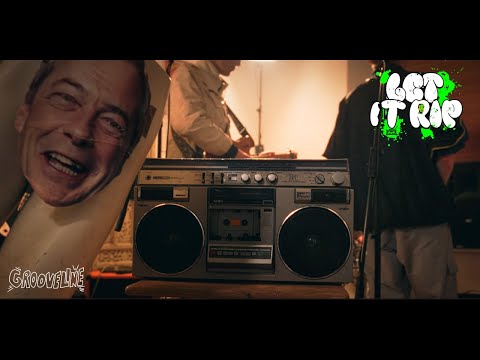
Tarach: “Let It Rip”.
Bainsy: Yeah, for sure. “Let It Rip” It’s the one that’s doing the best at the moment on Spotify. It’s the kind of perfect mix of our, kind of, hype buzz, and our musicality through all our different genres. And yeah, it just kind of captures really well, in the lyrics, bilingual lyrics, all about (being) on the session. So yeah, I think let it “Let It Rip”.
Tarach: I would say, “Let It Rip” definitely. I think it perfectly puts forward everything, Grooveline’s about.
Do you have a career highlight to date?
Bainsy: Honestly, it’s very, very early on, but for me, it’s probably that UK tour just gone. I mean, that felt like a big stepping stone for us.
Tarach: A huge step.
Bainsy: I remember us all talking after our last show, we were just really happy and just kind of like, at a loss for words. And we were all thinking like, it’s amazing that, independently, we can do that, we can make it work. And we’re not wanting to kill each other afterwards, or we haven’t, you know, we’re not all filing for bankruptcy. It can actually make sense and work.
Tarach: I think my career highlight to date… so we played the show in Brixton, three-hundred people came out, unbelievable, but by God, the afters after, was so good. It was so proper, like, such a beautiful afters. Everyone there was from Sligo.
Bainsy: It’s rare you get a bunch of Sligo lads in Brixton.
Tarach: Yeah, in the middle of Brixton, right beside the train station. That was probably my career highlight, yup.
Where can fans see you next?
Tarach: Well, if you’ve gotten a ticket for the Trinity Ball, fair play to you. But if you haven’t, like most people on the earth, 24 April, the Button Factory. It’s going to be the best show in Dublin, in the whole of April, for sure.
Bainsy: It’ll be the best show in Dublin this year so far.
Tarach: 100%. Fact about it.
What does the next year look like for Grooveline?
Tarach: Our plans are next year? We’re going to release more music, have more shows, play more international festivals, play Electric Picnic again, and we’ll see you later.
Bainsy: And I’m gonna get a pedal for my saxophone.
Tarach: Yeah, finally, four years incoming.
Bainsy: Four years too late, four years too late now.
Artists can submit themselves for consideration for the Fresh List here.